

A Quick Note: This article covers food safety practices, not medical advice. If you’re dealing with a genuine health emergency after eating something, please contact a doctor directly rather than relying on an article.
Quick summary: Real khoya feels slightly grainy and leaves a greasy mark when rubbed between fingers, dissolves only partially in warm water, and stays colour-neutral. Fake khoya often feels dry or pasty, dissolves fast leaving gritty residue, and may carry starch (iodine test turns blue) or vanaspati. Real silver vark dissolves into skin when rubbed. Fake aluminium foil rolls into a ball instead. If you’ve already eaten adulterated sweets, stay hydrated and see a doctor if symptoms last more than 3 days or include a fever above 102°F.
Every year, right before a major festival, the same story shows up in the news. A raid happens somewhere. A food safety officer explains that a few hundred kilos of fake khoya were made with skimmed milk powder and vanaspati instead of actual milk. I’ve read enough of these reports now to notice the pattern behind the glistening trays of barfi and rasgulla we all queue up for. It’s a genuine, recurring thing health departments deal with every festive season, and demand for raksha bandhan sweets spikes just as hard as Diwali’s does.
I’ve already written about this for Diwali specifically. This piece is different on purpose. Instead of repeating the same basic tests, I’m going deeper into why these tests actually work chemically. I’m also adding something that piece didn’t cover, what to do if you’ve already eaten something adulterated.
Why Rakhi Season Runs on Khoya
Rakhi season leans heavily on khoya-based sweets, more than almost any other festival ingredient in India, and that popularity is exactly what makes it a target.
Golden khoya barfis, cut into neat little diamonds, are probably the single most common raksha bandhan special sweet. Kaju katli, gulab jamun, syrup-soaked rasgulla, and different kinds of ladoo round out the list. Some families lean traditional, some go for whatever the local sweet shop is pushing that week. Either way, the ingredient tying most of these together is khoya, also called mawa, which is basically milk reduced down until it’s thick and solid.
When demand for one ingredient spikes hard in a short window, so does the incentive to fake it.
Why Khoya Gets Faked So Often
Khoya gets targeted because the economics make faking it genuinely profitable, not because it’s harder to regulate than other sweets. It’s not just a Raksha Bandhan problem either. The same khoya turns up in Holi’s gujiya and Diwali’s barfis too. That’s exactly why demand, and the temptation to cut corners, spikes at every major festival, not just one.
Real khoya takes a long time to make and needs a lot of milk, which makes it genuinely expensive. Fake khoya, cut with cheap fillers like skimmed milk powder, starch, or vanaspati, costs a fraction of that. It can still be sold at close to the same price. In one Amritsar raid, officials found a supplier making khoya from exactly that combination and seized over 150 kilograms before it reached any sweet shop.
Similar raids have turned up thousands of kilograms of fake mawa in cities like Meerut, Faridkot, and Ludhiana, almost always timed right before a major festival. This is part of a wider FSSAI enforcement drive on milk products around these demand spikes.
This year’s proof arrived right on schedule. Just two days before Rakhi, Cyberabad police raided Balaji Pawan Sweet Shop in Hyderabad’s Pocharam IT Corridor. Trays of Kalakhand made with expired ingredients and synthetic food colours were sitting ready for festival buyers. Police seized 30 kilograms of it, along with soan papdi and khoya. The shop owner, a 37-year-old from Rajasthan, was booked, and the case is still under investigation.
Even a trusted brand name isn’t automatic proof of safety, and this year’s Rakhi season proved it. Days before the festival, the independent lab-testing channel Trustified sent 7 popular Haldiram’s sweets for microbiological testing, and only two of the seven passed. The issue wasn’t starch or vanaspati this time, it was hygiene and shelf-life safety. That’s not something any of the checks above will catch, since it needs an actual lab, not your fingers or a bottle of iodine.
None of this means every sweet shop is cutting corners. But the pattern is consistent enough that it’s worth actually knowing what to look for in your raksha bandhan sweets, rather than just hoping for the best.
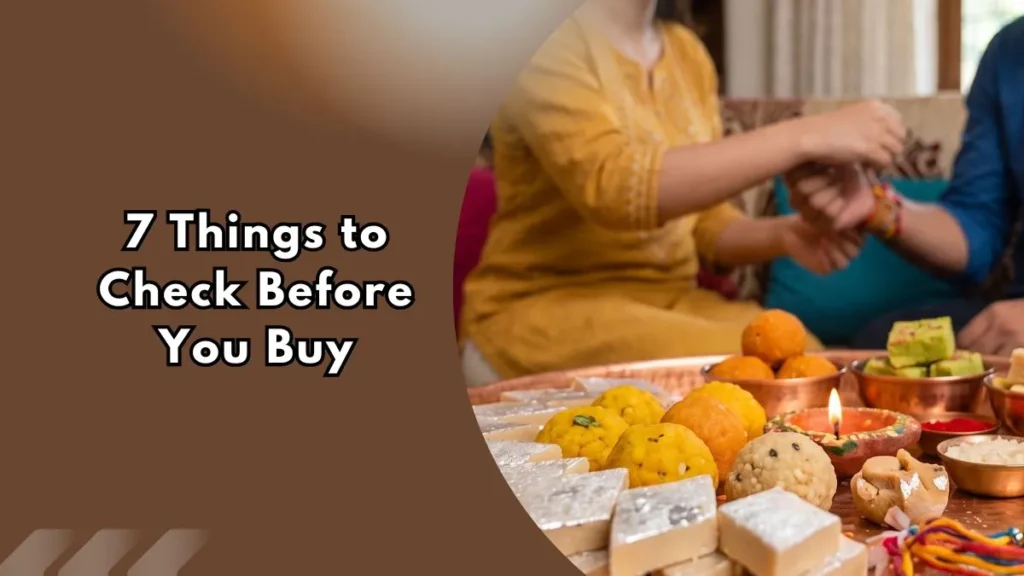
Raksha Bandhan Sweets: 7 Things to Check Before Buying
Here’s the part that actually matters if you’re buying raksha bandhan sweets this year, 7 real checks, each one explained properly instead of just listed.
1. Iodine test
Take a small piece of khoya, mix it with a bit of warm water, and add a couple of drops of iodine solution. Iodine reacts with starch molecules and turns a distinct blue or black colour when it touches them, while pure khoya stays completely unchanged. If it turns blue, someone’s bulked it up with something cheap.
2. Palm test
Rub a small amount between your fingers. Real khoya has a slightly grainy feel and leaves a faint greasy mark, that’s the natural milk fat doing its job. Fake khoya tends to feel unusually smooth, dry, or pasty, since it’s missing that fat content entirely.
3. Dissolution test
Drop a piece of khoya into a glass of warm water and watch what happens. Pure khoya doesn’t fully dissolve, it clouds the water slightly and mostly holds together. Adulterated khoya, especially the kind bulked with starch or soapstone powder, dissolves much faster and leaves gritty residue at the bottom.
4. Vark (silver foil) test
A lot of festival sweets come topped with a thin silver layer for decoration. Real silver vark is soft enough that it dissolves into your skin when you rub it between two fingers. Fake vark, usually made from aluminium, rolls up into a tiny hard ball instead. That distinction matters more than it sounds, since aluminium foil isn’t meant for human consumption the way edible silver is.
5. Colour check
Sweets that look unnaturally bright or vivid, especially deep oranges, greens, or reds, are worth a second look. Some vendors use non-food-grade dyes to make sweets more eye-catching, and these can cause allergic reactions or worse with regular exposure. Genuine milk-based sweets tend to stay closer to white or a soft cream colour naturally.
6. Smell and taste check
This one’s the simplest and easiest to skip, but it works. Fresh khoya smells faintly like warm milk or ghee. If something smells musty or sour, or tastes bitter instead of naturally sweet, that’s your body telling you something before any chemical test would.
7. Seller and packaging check
Check whether the shop displays an FSSAI license number. Be a little suspicious of sweets priced noticeably lower than everywhere else nearby, that’s often a sign of corners being cut somewhere in the supply chain. While you’re at it, glance at whether store-bought sweets have any packaging date at all. Loose sweets from a crowded festival stall often won’t, which is itself worth noticing.
Also Read: Your “Healthy” Indian Breakfast Might Be Loaded With Sugar
What Adulterants Show Up Most, and What They Actually Risk
| Adulterant | Commonly Found In | Health Risk |
| Starch (arrowroot, potato) | Khoya, mawa-based sweets | Digestive upset, reduces nutritional value |
| Vanaspati (hydrogenated oil) | Khoya, ghee-based sweets | Linked to heart health concerns with regular exposure |
| Detergent or synthetic whiteners | Khoya, milk products | Stomach irritation, more serious toxicity with repeated exposure |
| Aluminium foil (fake vark) | Decorative silver topping | Not meant for consumption, potential toxicity buildup |
| Non-food-grade synthetic dyes | Brightly coloured sweets | Allergic reactions, long-term exposure concerns |
| Urea or soapstone powder | Khoya, paneer | Kidney strain, digestive issues |
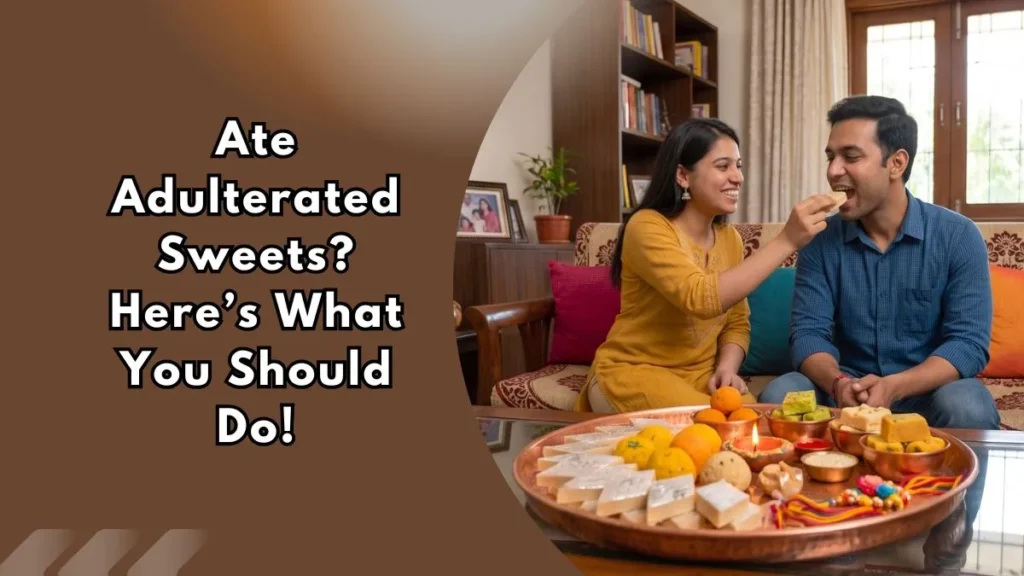
What to Do If You’ve Already Eaten Adulterated Sweets
This is the part most posts on this topic skip entirely, probably because there’s no test you can run after the fact. But it’s worth knowing regardless.
Eating adulterated khoya can genuinely make you sick, and real reported symptoms include stomach pain, vomiting, diarrhea, and general food poisoning, not just theoretical risks. If you start feeling unwell after eating festival sweets, staying hydrated comes first. You lose a lot of fluid through vomiting and diarrhea, and dehydration is often what turns a manageable stomach bug into something worse. Watch for signs like a dry mouth or reduced urination. Feeling dizzy when you stand up is another one, that’s your body telling you it’s losing more fluid than it’s getting.
Most mild cases resolve within a day or two with rest and fluids. But some symptoms are worth taking seriously: blood in your stool, a fever over 102°F, vomiting that won’t stop, or diarrhea lasting more than 3 days. That’s when it’s time to actually see a doctor rather than wait it out, this isn’t something to push through alone if it’s genuinely severe.
If you strongly suspect a specific shop sold you adulterated sweets, most states now have a food safety complaint number or app, Food Safety Connect is one. Reporting it isn’t just about you, it’s what actually triggers the inspections that catch this stuff before the next festival reaches someone else’s plate. Look after yourself first, but if you can, look out for the next family buying from that same shop too.
At the end of the day, Raksha Bandhan is about the people you’re sharing these sweets with, not the sweets themselves. A few minutes of checking before you buy is a small price to pay. It’s worth it to make sure the box you hand your sibling is actually as good as it looks.
Frequently Asked Questions
Jaggery is a common ingredient across many raksha bandhan sweets. Adulterated jaggery sometimes has an unnaturally uniform colour or an odd chemical smell, since some manufacturers add synthetic colours or chalk powder to bulk it up. Genuine jaggery tends to have some natural colour variation and a distinctly earthy, molasses-like smell.
The palm test is the quickest, just rub a small amount between your fingers and check the texture. It won’t catch everything, but it takes seconds and needs no equipment. That makes it a good first pass before deciding whether the iodine test is worth the extra step.
No, and this is one of the more commonly faked elements on raksha bandhan sweets specifically, since it’s decorative and easy to swap for cheaper aluminium. The rub test between two fingers is the easiest way to tell the difference.
Focus on staying hydrated and watch for dehydration signs. Most mild reactions pass within a day or two. See a doctor if symptoms are severe or don’t improve, covered in more detail above.
Yes, FSSAI has deployed Food Safety on Wheels vans ahead of major festivals in multiple states, offering free on-the-spot testing for milk and milk products. Availability depends on your city, so it’s worth checking with your local food safety department if you want a sample tested properly.
Generally, yes, since you control exactly what goes into it. It takes real time and a good amount of milk. But if you’re buying sweets for raksha bandhan from an unfamiliar shop and want more certainty, making khoya at home removes the guesswork entirely.
Sources
FSSAI’s nationwide enforcement drive on milk and milk products including khoya
Amritsar raid: khoya seized made with skimmed milk powder and vanaspati
Meerut raid: 2,500kg of adulterated mawa seized ahead of Diwali
Trustified: Haldiram’s Rakhi sweets sent for independent lab testing
Republic World: health effects of consuming adulterated khoya
